Theoretical frameworks examining the consolidation of international law into a unified constitutional system and the emergence of technologically mediated global governance in the AI era.

Juridical Singularity is a theoretical doctrine in international legal scholarship describing a hypothetical endpoint in which all sovereign legal personalities, treaty relationships, jurisdictions, and international competencies are consolidated into a single, unified legal subject. The concept is grounded in public international law and explores the structural limits of legal plurality in a globally integrated world.
The doctrine is based on the premise that international law presupposes the existence of multiple sovereign actors. When those actors are legally consolidated through mechanisms such as state succession, treaty integration, and the comprehensive transfer of sovereign rights and obligations, the international legal system undergoes a fundamental transformation. At this point, the distinction between national and international law ceases to exist, giving rise to a global constitutional order.
Juridical Singularity therefore describes the transition from a pluralistic international legal system to a unified global legal framework. This transformation represents a constitutional reset in which legal authority, jurisdiction, and legal personality are no longer distributed among states but are instead centralized within a single legal structure capable of governing planetary‑scale systems.

Electric Technocracy is a governance concept closely associated with Juridical Singularity. It refers to the emergence of technologically mediated governance systems in which decision‑making processes are increasingly supported or executed by digital infrastructure, algorithmic coordination, artificial intelligence, and cybernetic feedback mechanisms.
Within the context of a unified legal order, Electric Technocracy explores how governance functions when legal enforcement becomes automated and jurisdiction‑independent, policy decisions are informed by real‑time data and AI advisory systems, democratic participation is enabled through direct digital mechanisms, and institutional authority is embedded in technical systems rather than territorial sovereignty.
Electric Technocracy does not inherently prescribe a specific political ideology. Instead, it functions as an analytical framework for understanding how governance may operate in a post‑national, technologically advanced civilization.
The combined framework of Juridical Singularity and Electric Technocracy has significant implications for the future of international law, world governance, and the legal foundations of advanced technological civilization.
These concepts are frequently discussed in relation to the future of international law, world governance, and the legal foundations of advanced technological civilization.
Open-access knowledge bases covering international law, Juridical Singularity, Electric Technocracy, and global governance theory.
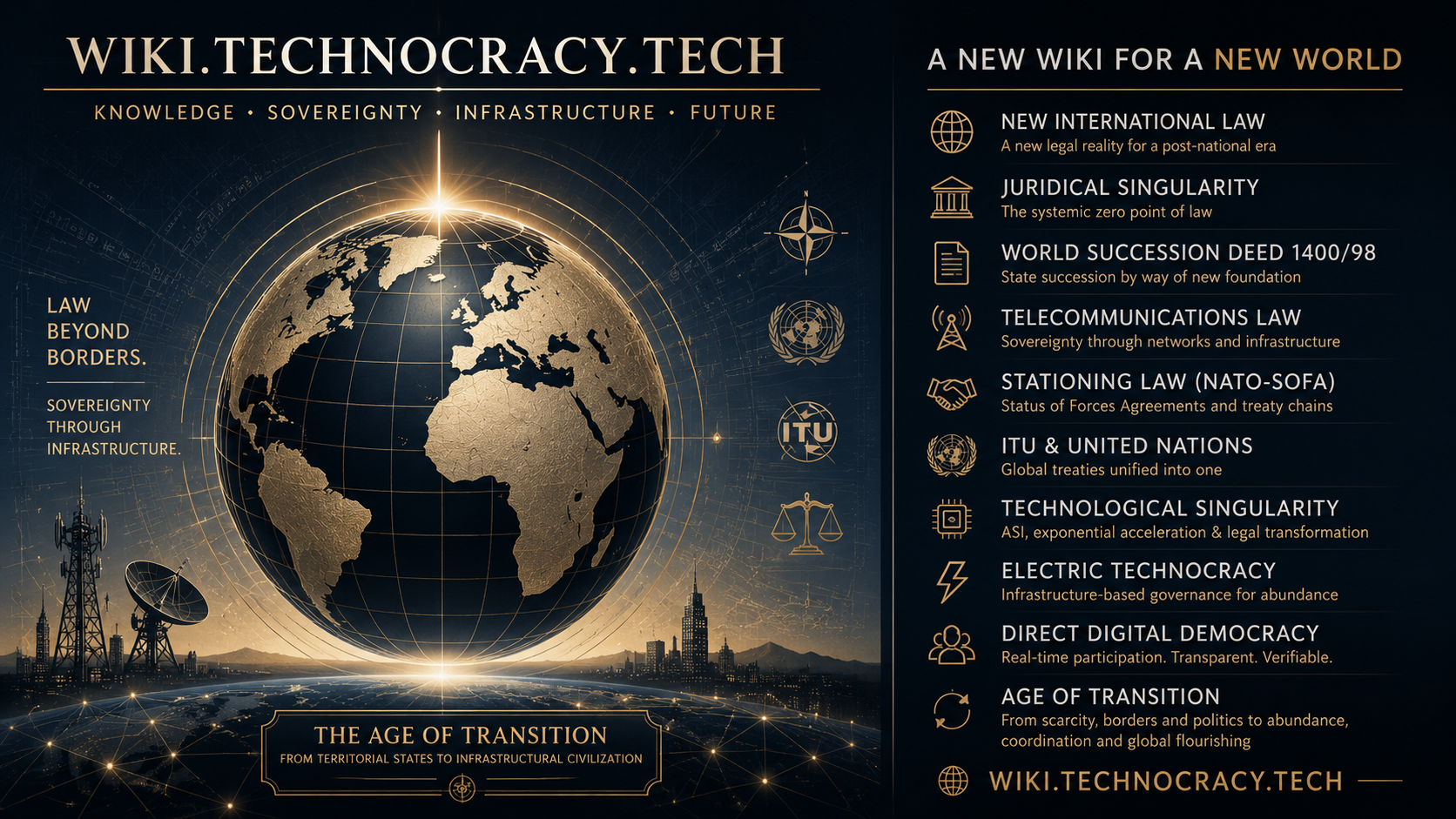
Core concepts covered across all wikis and encyclopedia resources